Three years ago, I was the one sitting at my kitchen table two nights before the Ontario barrister exam — surrounded by indices, a half-empty cup of tea, and a stack of flow charts I had colour-coded one too many times.
Two kids asleep in the bedroom. A head full of doubt — and a quiet group of mentors, professors, lawyers, and friends, who kept telling me: you have done harder things than this.
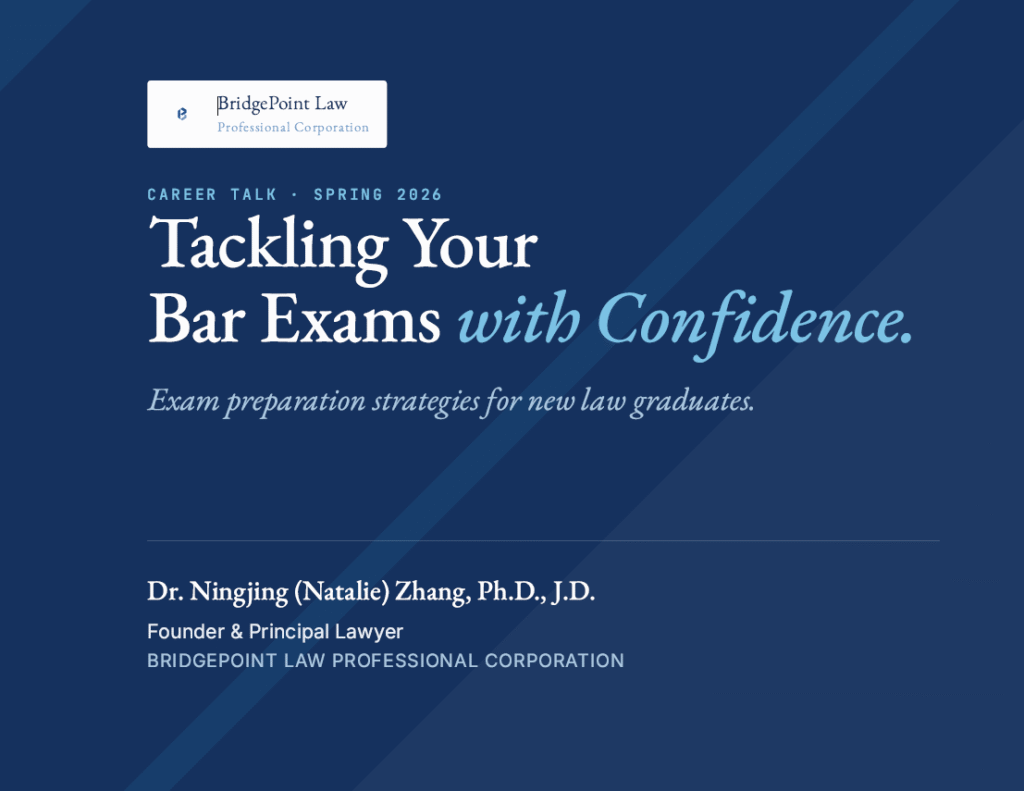
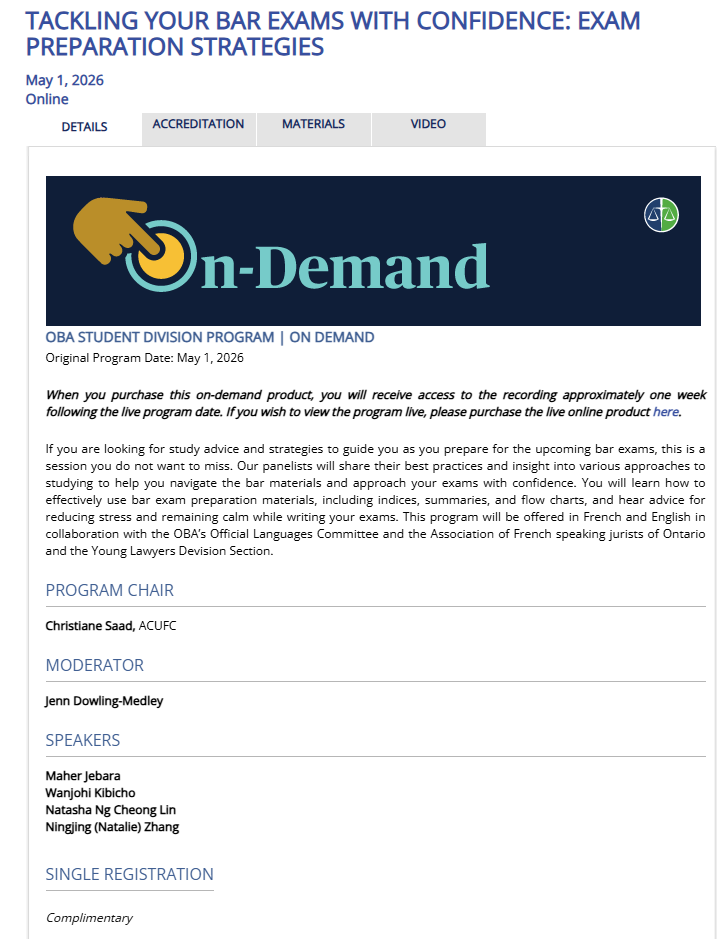
They were right. And on May 1, 2026, I get to pay some of that forward as part of the Ontario Bar Association’s panel, “Tackling Your Bar Exams with Confidence: Exam Preparation Strategies.” Almost 200 law school graduates from across Ontario will join us as we share what worked, what didn’t, and how to walk into the exam room without losing your nerve.
This post collects some of what I will be sharing on the panel — for anyone preparing for the Ontario barrister exam or solicitor exam this summer, or quietly bookmarking it for next year.
What is the Ontario Bar Exam?
The Ontario bar exam is, in fact, two exams. To be licensed by the Law Society of Ontario (LSO), every candidate must pass both:
- the Barrister Licensing Examination, focused on litigation, criminal, family, and public law; and
- the Solicitor Licensing Examination, focused on real estate, business, estates, and professional responsibility.
Both are open-book, multiple-choice, full-day examinations. Candidates may bring their own materials, including printed study aids and indices. In practice, the materials a candidate brings into the room — and how well they know them — are the single most important factor in how the day goes.
Strategy 1 — Build (Don’t Just Buy) Your Indices
The biggest mistake I see candidates make is treating someone else’s index as their own. There are excellent commercial indices on the market — Emond, OsgoodePD, the various student-run indices passed down by previous cohorts. Use them as a starting point. But the index that will actually save you in the exam room is the one you have built and used yourself.
When you build your own index, you remember where things live. You remember that the limitation period for a particular cause of action is two pages after a heading you marked in green. That muscle memory is the difference between flipping through three modules and finding the right paragraph in twenty seconds.
Practical tips:
- Start indexing the same day you receive your materials. Do not wait.
- Use a consistent colour-coding system across all subjects.
- Index by issue, not by topic. The exam asks issues; the materials are organized by topic. Your job is to bridge the two.
- Cross-reference. If a doctrine appears in two modules, both entries should point to each other.
Strategy 2 — Use Summaries to Triangulate, Not Replace, the Materials
A summary is a study tool. The Law Society materials are the source of truth.
The most dangerous use of a summary is to read it instead of the materials. You end up with a confident-sounding answer that the exam happens to disagree with. A safer approach: read the materials first, write your own summary in your own words, and then compare yours against a commercial summary or a study group’s. The discrepancies are where the learning lives.

Strategy 3 — Flow Charts Are for Decisions, Not Decoration
Flow charts are not pretty pictures. A good flow chart is a decision tree that walks you from a fact pattern to an answer in the smallest possible number of steps.
Reserve flow charts for the questions that have a knowable algorithm — limitation periods, court jurisdiction, ethical conflicts, real-estate closing checks. Do not flow-chart things that are inherently judgment-based. Those belong on a separate one-page checklist of factors.
If you find yourself making a flow chart prettier at 2 a.m., put it down. Make a worse-looking one that gets you to the answer faster.
How Do You Manage Stress During Bar Exam Week?
Some honest things I tell every candidate I mentor:
- Sleep is non-negotiable. Two nights before the exam matters more than the night before — that is when memory consolidates. Protect it.
- Move your body every day — even a twenty-minute walk. Your nervous system runs your brain. Take care of the host.
- Practice the logistics in advance — where the exam centre is, what is in your bag, how you will get there if transit fails. Surprises eat focus.
- Have one person on call. A friend, a partner, a parent, a mentor — someone who can answer your phone at 5 a.m. on exam day if you need to hear a calm voice.
- Plan the post-exam evening. Knowing what you are doing after walking out of the exam room makes the day finite. The bar exam is one Wednesday — not your whole life.
Why Mentorship Matters for New Lawyers in Ontario
I sat my own bar exam as a single mother, a refugee-turned-lawyer, and the first person in my immediate family to pursue post-secondary education. I had no script for any of it. What I had were mentors — professors at Queen’s Law, lawyers in private practice, the women who walked alongside me at the shelter where my children and I lived before law school. They answered my calls and texts and emails at all hours, and not once made me feel like a burden.
Mentorship is not a soft skill. For many of us, it is the difference between getting through and not getting through.
If you are writing the bar this summer, find your people now. Reach out to a recent call. Ask the question you are afraid is too basic. Most lawyers I know are happy to take that call — because someone took ours.
And if you are already practising and reading this: please pick up the phone when a student or a new call reaches out. Ten minutes of your time can change the shape of someone’s career.
About the OBA Bar Exam Preparation Panel — May 1, 2026
The Ontario Bar Association’s Student Division is presenting “Tackling Your Bar Exams with Confidence: Exam Preparation Strategies” on May 1, 2026, online, free of charge. The program is offered in both French and English, in collaboration with the OBA Official Languages Committee, the Association of French-speaking Jurists of Ontario (AJEFO), and the OBA Young Lawyers Division.
Panelists include Maher Jebara, Wanjohi Kibicho, Natasha Ng Cheong Lin, and myself, with Christiane Saad (ACUFC) chairing and Jenn Dowling-Medley moderating.
Registration is complimentary: Register on the OBA website.
Download the slides: Tackling Your Bar Exams — BridgePoint Law (PDF, 1.4 MB) — the full slide deck from the OBA panel session, with the strategies, indices examples, and stress-management tips covered above.
Final Thoughts
The Ontario bar exam is hard. It is supposed to be. But it is not bigger than you, and it is not bigger than the people who will help you through it. Three years ago I sat at my kitchen table convinced I might fail. I did not. Most of the candidates I have mentored since have not, either. With the right materials, the right rhythm, and the right people on the other end of the phone, you can do this too.
If your firm, law school, or student association would like a guest speaker or a written piece on bar exam preparation, articling, or the path into Ontario practice — particularly for first-generation, immigrant, or non-traditional candidates — I would be glad to hear from you.

About the Author
Dr. Ningjing (Natalie) Zhang, Ph.D., J.D. is the founder and principal lawyer of BridgePoint Law Professional Corporation, with offices in Kingston, Toronto, and Shanghai. She was called to the Ontario Bar on March 1, 2024 and practises in immigration and refugee law, business and corporate immigration, real estate, and civil litigation, appearing before the Federal Court, the Refugee Protection Division, the Refugee Appeal Division, and the Ontario Superior Court of Justice. She is trilingual (English, Mandarin, Cantonese) and accepts Legal Aid Ontario certificates. She holds a Ph.D. in History from Fudan University, an MA in Gender Studies from Queen’s University, and a J.D. from Queen’s Law. Learn more at bridgepointlaw.ca.
Disclaimer: This blog post is for informational purposes only and does not constitute legal advice or advice on the Law Society of Ontario licensing process. If you need legal advice or assistance regarding the licensing process or any other matter, please consult with a licensed lawyer in Ontario.
Ask us about your matter
Tell us where your file stands and we will reply within two business days. Please do not send documents or identification numbers in this first message.