A reflection from Ningjing Natalie Zhang, founder of BridgePoint Law Professional Corporation in Kingston, Ontario.
It isn’t often that an immigration lawyer stops to write about a single Temporary Resident Visa approval. Visas get issued every day. Refusals, too. But sometimes a file comes across the desk where the law is only half the story, and the other half is what happens the moment an envelope is opened in a living room on the other side of the world.
This week, a client of BridgePoint Law received a Canadian Super Visa that most lawyers would have quietly called improbable.
Three prior refusals. A seven-month overstay in Canada on an earlier visitor record. A grandfather and a grandmother who, until this approval, had only ever met their Canadian-born grandchildren through the pixelated reassurance of a video call.
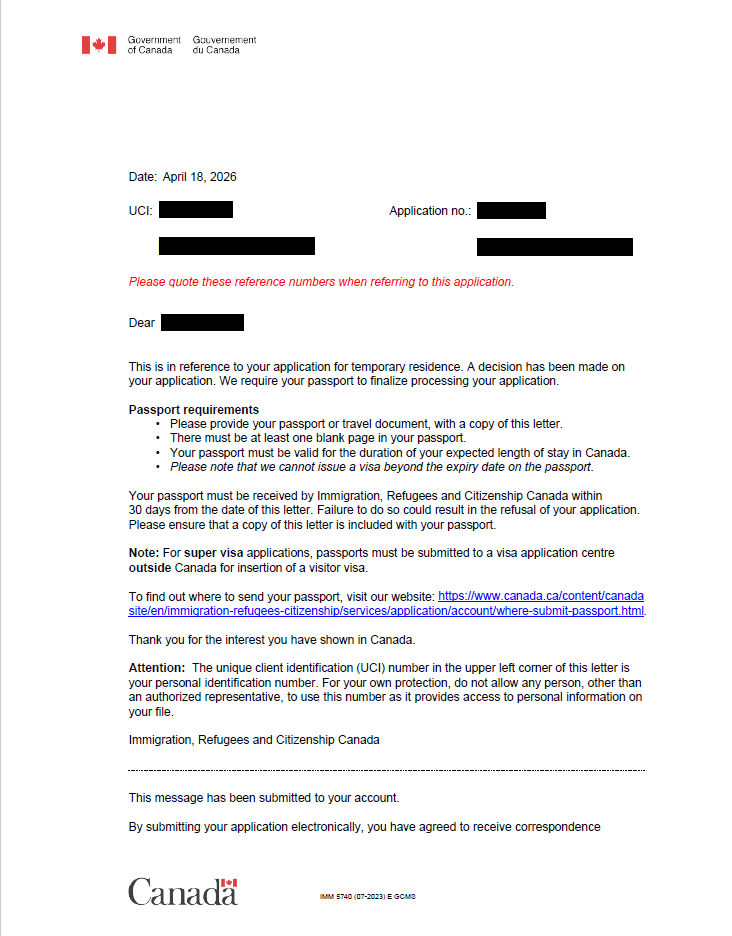
We filed the application on March 8. This week, the passport came back with the visa counterfoil inside.
What Is a Canadian Super Visa?
The Super Visa is a special category of multiple-entry Temporary Resident Visa designed for the parents and grandparents of Canadian citizens and permanent residents. Unlike a standard visitor visa, it allows eligible applicants to stay in Canada for up to five years at a time and is typically issued as a 10-year multiple-entry visa.
To qualify, applicants must:
- Be the parent or grandparent of a Canadian citizen or permanent resident;
- Have a signed letter of invitation from their child or grandchild in Canada;
- Be supported by an inviter who meets the minimum income threshold (Low Income Cut-Off, LICO);
- Hold Canadian-approved private medical insurance with minimum coverage of CAD $100,000 for at least one year; and
- Undergo an immigration medical examination (IME).
Those are the procedural requirements. The harder test — and the one that most refusals are built on — is the discretionary one: an Immigration, Refugees and Citizenship Canada (IRCC) officer must be satisfied that the applicant is a genuine visitor who will leave Canada at the end of the authorized stay.
That is where this file was supposed to fail.
The File Everyone Else Would Have Turned Away
Three numbers tell the story:
- 3 prior refusals from IRCC;
- 7 months of overstay on a previous visit to Canada;
- 0 prior applications that had been prepared with a full legal strategy.
In a sector where even one refusal typically draws a more cautious review on every application that follows, three is often treated as a reputational cliff. Add an overstay of more than half a year, and the odds — as many practitioners would assess them — hover somewhere between “unlikely” and “not worth filing.”
But statistics are not the same as people.
The clients were grandparents in their late sixties. Their daughter and son-in-law had, during the earlier visit in question, been navigating a serious medical crisis at home in Canada. The grandparents stayed to care for the children while the family pieced itself back together. The overstay was not a hidden plan to remain in Canada. It was a grandmother refusing to put a small child into daycare during chemotherapy.
None of that context had ever reached an IRCC officer.
How BridgePoint Law Rebuilt the File
We treat refused files the way a trial lawyer treats a lost motion: we read the reasons first, and the law second.
1. Addressing Every Prior Refusal Head-On
We did not ignore the refusals; we catalogued them. Each prior decision, and the officer’s GCMS notes obtained through an Access to Information and Privacy (ATIP) request, became an anchor for a paragraph of the submission letter. A refusal unaddressed is a refusal repeated.
2. Reframing the Overstay
The overstay was not minimized — it was explained. Medical records (with the family’s consent), affidavit evidence from the inviter, and proof of voluntary departure at the end of the extended stay were put in front of the officer in a single, chronological, and human narrative.
3. Establishing Strong Ties Abroad
A Super Visa applicant must persuade an officer that they will return home. That is rarely accomplished with bank statements alone. We supplemented the financials with:
- Property ownership documents;
- Long-term community ties (religious, volunteer, and caregiving responsibilities in the home country);
- Pension and ongoing medical treatment plans anchored abroad;
- Concrete return obligations tied to family events and an aging elderly parent.
4. Strengthening the Inviter’s Side of the File
The inviter’s income, insurance policy, and letter of invitation were prepared as one integrated package. The medical insurance was issued by a Canadian provider, confirmed to meet the $100,000 minimum, and paid up front for the first year of intended stay. The letter of invitation was drafted to explain, specifically, why a Super Visa — rather than an ordinary visitor visa — was the right instrument for this family.
5. Asking for the Super Visa, Not a Visitor Visa
This is a point missed surprisingly often. A Super Visa is applied for by requesting it; it is not automatic. The submission letter explicitly invoked the Super Visa pathway, cited the applicable Operational Instructions, and made the case that the statutory and policy requirements were met.
The Phone Call
The passport arrived this week. The daughter called the office in tears before her parents had even finished unwrapping the courier envelope.
“My children have never been hugged by their grandparents. Never.”
That sentence will stay with me for a long time.
Why This Matters, Right Now
Canadian immigration law is passing through one of its hardest seasons in a decade. Bill C-12 has expanded enforcement powers. Removal orders are being executed at a pace unseen in recent years. Application processing times remain long, refusal rates on discretionary categories remain elevated, and families who have played by the rules are, understandably, afraid.
Against that backdrop, it is tempting — even for lawyers — to write off difficult files. To say: “three refusals, don’t bother.” To say: “an overstay, forget it.” To say: “the current environment makes it impossible.”
It doesn’t.
What the current environment does do is raise the bar for how thoroughly, honestly, and humanely a file must be presented. Applications that would once have been approved on half a letter are now being refused. But applications prepared as if each decision matters — as if the officer deserves the full story and the client deserves a real advocate — are still being approved.
This family’s approval is one of those.
If You Have Been Refused Before — Read This
A repeat refusal is almost always caused by one of three things:
- Submitting the same file, or a cosmetically identical file, a second time. An officer who refused a file is not waiting to be persuaded by the same evidence in a new envelope. New applications need new evidence.
- Failing to request and read the GCMS notes. You cannot fix what you cannot see. The notes are the officer’s reasoning, and they are available through an ATIP request.
- Misdiagnosing the refusal. “Insufficient ties” is a conclusion, not a cause. The actual reason is buried in the notes — weak travel history, unclear purpose of visit, inconsistent statements, questionable funds, or undisclosed prior immigration history. Each of those is addressed differently.
A proper reapplication is not a resubmission. It is a response.
Frequently Asked Questions
Can I apply for a Super Visa if I have been refused before?
Yes. There is no statutory bar on reapplying after a refusal. A refusal is, however, a fact that must be disclosed on the new application and addressed in the submission. A new application that ignores a prior refusal will almost always be refused again.
Does an overstay permanently bar a future Super Visa?
No. An overstay — even one of several months — is not a statutory bar to a future visitor visa or Super Visa. It is, however, a significant credibility and compliance concern that must be explained with documentary evidence and a coherent timeline. The length of the overstay, the reason for it, and the applicant’s conduct at the end of the stay all matter.
How long does a Super Visa take to process?
Processing times vary significantly by country of residence. Most Super Visa applications are currently processed within two to six months from the country of submission, though high-volume posts and refused files typically take longer. For a complex or previously refused file, preparation time is often longer than processing time.
Do I need a lawyer to apply for a Super Visa?
No. A straightforward Super Visa application for a first-time applicant with clean records, strong ties, and a well-documented inviter does not usually require a lawyer. A refused file, an overstay history, a previously misrepresented record, or a medical inadmissibility concern is a very different situation — and is where legal representation becomes valuable.
Where is BridgePoint Law located?
BridgePoint Law Professional Corporation is based in Kingston, Ontario, Canada, at 275 Ontario Street, Suite 301. The firm represents clients across Canada and internationally, with a focus on Canadian immigration litigation, family and business immigration, refugee law, and US cross-border matters.
Small Reunions, Dark Seasons
Immigration law is not only statutes and procedure. On the best days, it is the piece of paper — or the stamp, or the counterfoil — that lets a family hold each other again.
A grandmother will step off a plane later this year and meet a grandchild who knows her only from a screen. A grandfather will sit at a dinner table that has had an empty chair since 2019. A mother in Kingston will, for the first time in a very long time, not be the one holding everyone together.
In a dark season for Canadian immigration, these are the small lights that remind the rest of us why the work is worth doing.
If your file has been refused — once, twice, three times — and you have been told, quietly or otherwise, that it isn’t worth trying again, we would be glad to read it.
Contact BridgePoint Law · Individual Immigration services · Family Immigration services · Read more client stories
Written by Ningjing Natalie Zhang, J.D., Ph.D., founder of BridgePoint Law Professional Corporation and a member of the Law Society of Ontario and the American Immigration Lawyers Association.
Ask us about your matter
Tell us where your file stands and we will reply within two business days. Please do not send documents or identification numbers in this first message.