
I came to law later than most.
A refugee who lived in a women’s shelter with my children before law school. A first-generation post-secondary student. A single mother who studied for the bar exam after the kids were asleep. When I was called to the Ontario Bar on March 1, 2024, I assumed the hardest part was behind me.
It wasn’t.
The hardest part of this profession is rarely the law. It’s the rooms. The quiet hierarchies. The places where a junior voice is not always made welcome. The bullying that is easier to feel than to name. And the loneliness of carrying all of that without language for it.
That is why I was honoured, last Tuesday, to be on this panel.
The Panel: A Conversation Our Profession Actually Needs
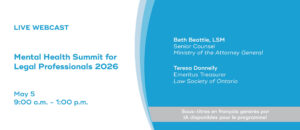
On Tuesday, May 5, 2026 (10:55 a.m. – 11:50 a.m. ET), I joined the Law Society of Ontario’s Mental Health Summit for Legal Professionals 2026 for a conversation we have needed to have out loud for a long time:
“Ways to Overcome Hierarchy, Bullying and Isolation in the Legal Professions”
I shared the panel with three people whose work I have learned a great deal from:
- The Hon. Justice Brook Greenberg, Supreme Court of British Columbia
- Lai King Hum, Hum Law Firm; LSO Discrimination and Harassment Counsel
- Marian Jacko, KC, Assistant Deputy Attorney General, Attorney General | Procureur général (Ontario)
We did not pretend the work was easy or solved. We shared what we have actually tried — what worked, what didn’t, what we wish someone had told us in year one.
What I Said
I said the quiet parts out loud.
That for a young lawyer who is also an immigrant, a single parent, a second-career entrant, a racialized person, or any combination of those — the rooms feel different. The math runs in your head before you speak: Is it safe here? What does it cost me if I say something? Will I be heard as competent, or just as the loudest person who needed something?
I said that hierarchy in law is not always mentorship. Healthy hierarchy looks like supervision, feedback, and being trusted with a hard file. Unhealthy hierarchy looks like silence, gatekeeping, and being made to feel that asking is itself a weakness.
I said that isolation is the quiet cost of this profession — and it does long-term damage in a way that headline-bullying does not. When I opened BridgePoint Law in December 2024, the loneliness was its own learning curve. For solo and small-firm lawyers, community is infrastructure.
What I Heard
I heard a panel that did not flinch.
I heard about the structural conditions that quietly tolerate harm — and about the small daily practices senior lawyers can adopt to interrupt them. I heard about the law society’s role, the firm’s role, the colleague’s role, and finally, the lonely role of the person experiencing it.
I also heard from people in the audience — over chat, over email afterwards, over LinkedIn — saying thank you for naming this. Many asked not to be quoted. That, on its own, is data.
What I Am Still Sitting With
Six days later, three thoughts have not left me.
1. Naming it is not complaining — it is professional accuracy.
We are trained to be precise about the law. We are remarkably imprecise about the everyday harms that wear lawyers down: the offhand comment in a meeting, the meeting you weren’t invited to, the credit reassigned, the file pulled. Calling those things by their right names is not weakness. It is the same craft we use everywhere else.
2. The profession was built for a narrower kind of lawyer than the one we are now.
The redesign is happening in slow motion — one conversation, one panel, one mentor, one small firm at a time. Six years of this Summit have made the change visible. But the speed of the change is set by who shows up.
3. The fastest way to change the math is to create safety on purpose.
If you are a senior lawyer or a managing partner reading this: the junior who just went quiet in your meeting is not lazy or disengaged. They are doing math you cannot see. You can change the math.
Why This Summit Matters — and How to Catch What You Missed
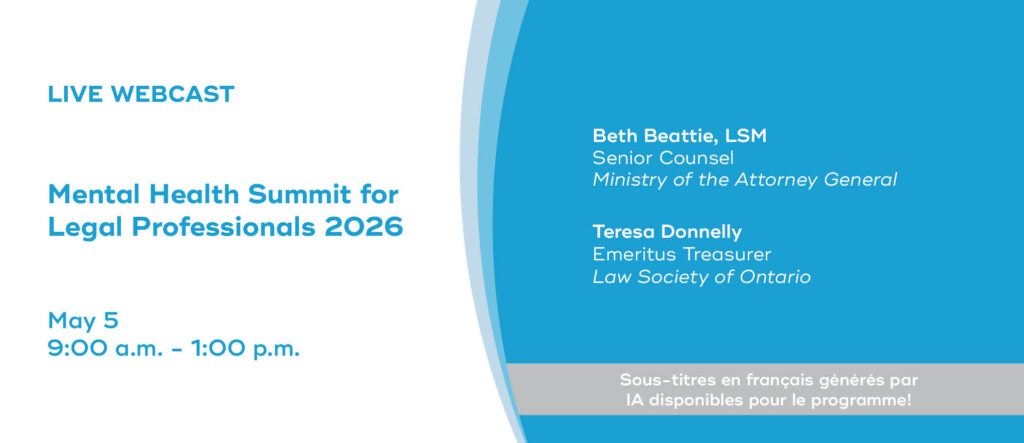
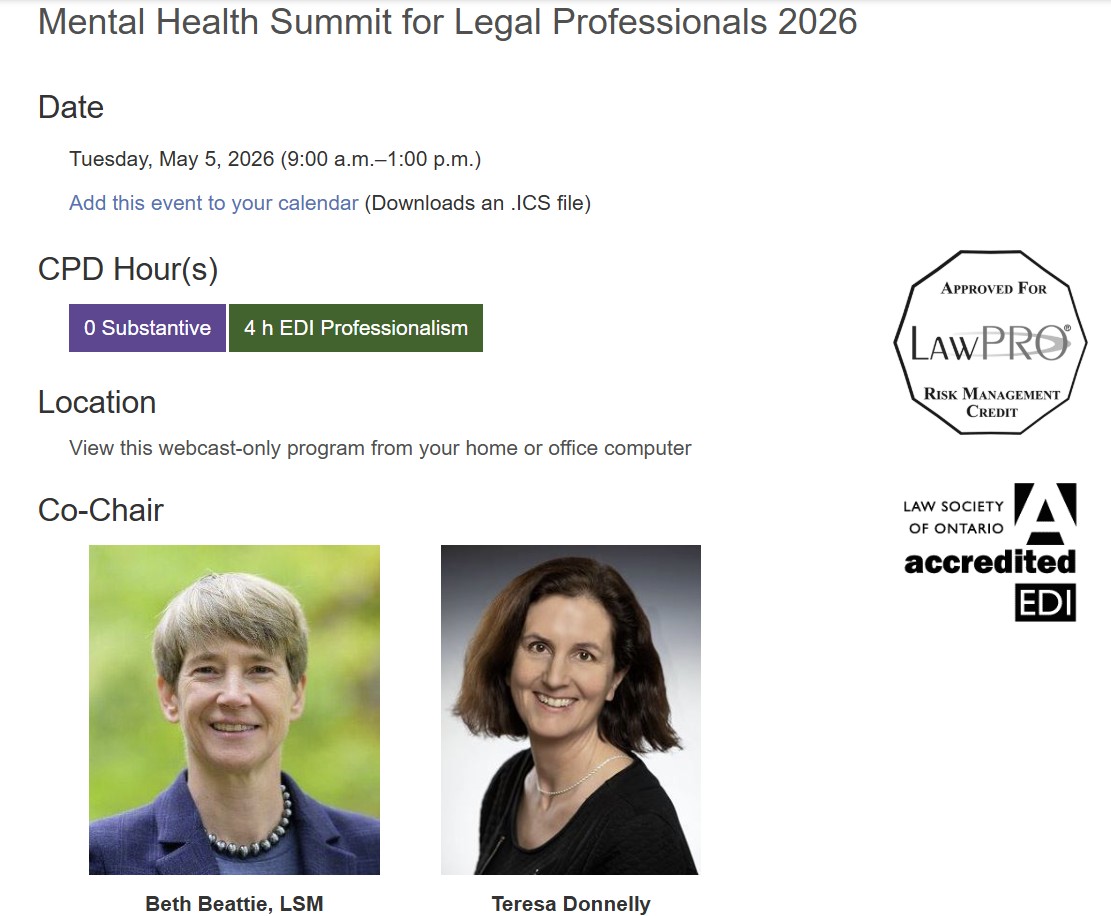
The full Summit, now in its sixth year, was co-chaired by Beth Beattie, LSM and Teresa Donnelly (Emeritus Treasurer, LSO).
The morning’s other speakers included:
- The Hon. Justice Suzan Fraser, Ontario Superior Court of Justice
- Doron Gold, The Lawyer Therapist
- Katherine Cooligan, Cooligan Yehia LLP
- Kirsten Marsh, McCarthy Tétrault LLP
- Dimple Dhabalia, Roots in the Clouds | by Dimple Dhabalia
- Jason Ward Law, LLC
- Adam Brooks, Ministry of the Solicitor General
- Alastair Clarke, Clarke Immigration Law
- Hayley Pitcher, Court of Appeal for Ontario
- Lauren Linton, Ministry of Municipal Affairs and Housing
- Karen Seeley, McAuley Law
- Tanya Parker Wallace, Parker Wallace Family Law
- Shelina Lalji, JUSTICEJOLT
The Summit ran Tuesday, May 5, 2026, 9 a.m. – 1 p.m. ET, by live webcast — four hours of EDI Professionalism CPD, free of charge.
If you are a lawyer, paralegal, articling student, or law student in Ontario, the LSO is the place to look for the recording.
To Anyone Who Has Ever Felt Small in a Room You Earned the Right to Be In
You are not the problem.
If this piece resonated, please share it — and bring a colleague who you suspect needs it but won’t ask. That is, quietly, how the profession changes.
About the Author
Dr. Ningjing (Natalie) Zhang is the founder and principal lawyer of BridgePoint Law Professional Corporation, with offices in Kingston, Toronto, and Shanghai. A refugee-turned-lawyer, first-generation post-secondary student, and single mother, she was called to the Ontario Bar on March 1, 2024 and practises immigration and refugee law, business immigration, real estate, civil litigation, and corporate law before the Federal Court, the Refugee Protection Division and Refugee Appeal Division, and the Ontario Superior Court of Justice. She accepts Legal Aid Ontario certificates and serves a significant Chinese-speaking client base in English, Mandarin, and Cantonese.
This piece is adapted from her remarks at the Law Society of Ontario’s Mental Health Summit for Legal Professionals 2026, held by live webcast on May 5, 2026.
natalie@bridgepointlaw.ca
(613) 417-1850 | Toll Free (877) 307-6193
Kingston · Toronto · Shanghai
Ask us about your matter
Tell us where your file stands and we will reply within two business days. Please do not send documents or identification numbers in this first message.