A Canadian visa application is decided by one person: an individual IRCC officer, not a panel or a computer. But not every officer holds the same legal power. Officers exercise authority that has been formally delegated to them, and for some findings, such as misrepresentation under section 40 of the Immigration and Refugee Protection Act (IRPA), the officer who assesses the file is usually not the officer who may lawfully sign the refusal. Understanding who decided, at what level, and whether they held the authority to do so is often the difference between a refusal that can be challenged and one that cannot.
Key Takeaways
- Decisions at a visa office are made at different levels: non-designated officers, designated immigration officers with a wider range of powers, and the program manager who heads the immigration section.
- Delegated authority is published. IRCC’s Instrument of Designation and Delegation sets out which officers may exercise which powers under IRPA.
- A misrepresentation refusal normally requires the concurrence of an officer holding the delegated authority. Whether that concurrence appears in the notes is worth checking.
- Published processing times reflect the fastest 80 percent of past applications, which is why your file can be well past the posted time and still be considered normal.
- IRCC’s own guidance says reconsideration is for exceptional cases. Disagreement with the outcome is not enough; a procedural failure or a clerical error is a far stronger basis.
Three levels of decision-maker at a visa office
Visa offices are not flat. Broadly, three levels of officer make decisions:
Non-designated immigration officers generally work on temporary residence applications, such as visitor visas, study permits and work permits.
Designated immigration officers hold a wider spectrum of delegated powers, including findings that carry serious consequences for the applicant.
The program manager, sometimes described as the immigration program manager or a Canada-based officer, heads the immigration section at the mission. This position is typically filled for a posting of a few years. The program manager’s priorities shape what the office treats as urgent, which categories move quickly, and how aggressively certain grounds of refusal are used.
This matters more than it sounds. At the program manager level, only one or two people are involved in a given decision, and the discretion exercised is broad. A change of program manager can visibly change the profile of decisions coming out of an office, which is one reason a category that was being approved routinely can start attracting refusals without any change in the law.
What delegated authority means, and why it matters
IRPA confers powers on the Minister. Those powers are then designated and delegated to specific classes of officer through IRCC’s Instrument of Designation and Delegation, which IRCC publishes. The document identifies, power by power, which officers may exercise it.
The practical use is straightforward. If a refusal rests on a ground that requires a particular level of officer, and the file does not show that an officer at that level made the decision, then the validity of the decision may be open to question.
The clearest example is misrepresentation. Section 40(1)(a) of IRPA makes a foreign national inadmissible for directly or indirectly misrepresenting or withholding material facts relating to a relevant matter that induces or could induce an error in the administration of the Act. In practice the assessing officer makes a recommendation, and the refusal must be made by someone holding the delegated authority, whether at the visa office or at a case processing centre in Canada. That second step is the concurrence.
So when a misrepresentation refusal is reviewed, one of the first questions is whether the concurrence by a delegated authority appears in the officer’s notes at all. If it does not, that is a point worth raising. Obtaining the notes is a separate exercise, and we cover how to do it in our guide to requesting GCMS notes after a refusal. The substantive test for a section 40 finding is discussed in our page on misrepresentation under IRPA section 40.
The life cycle of a file
For a temporary resident visa submitted online, the path is roughly as follows:
- The application goes to a case processing centre.
- It is retained there or dispatched to a visa office.
- It is triaged, then assigned to an officer.
- If the officer is absent or the office is overloaded, it may be transferred to another officer, sometimes at a different visa office.
- The officer assesses the file.
- On temporary residence applications, there is often no procedural fairness letter before a decision.
- The application is approved or refused.
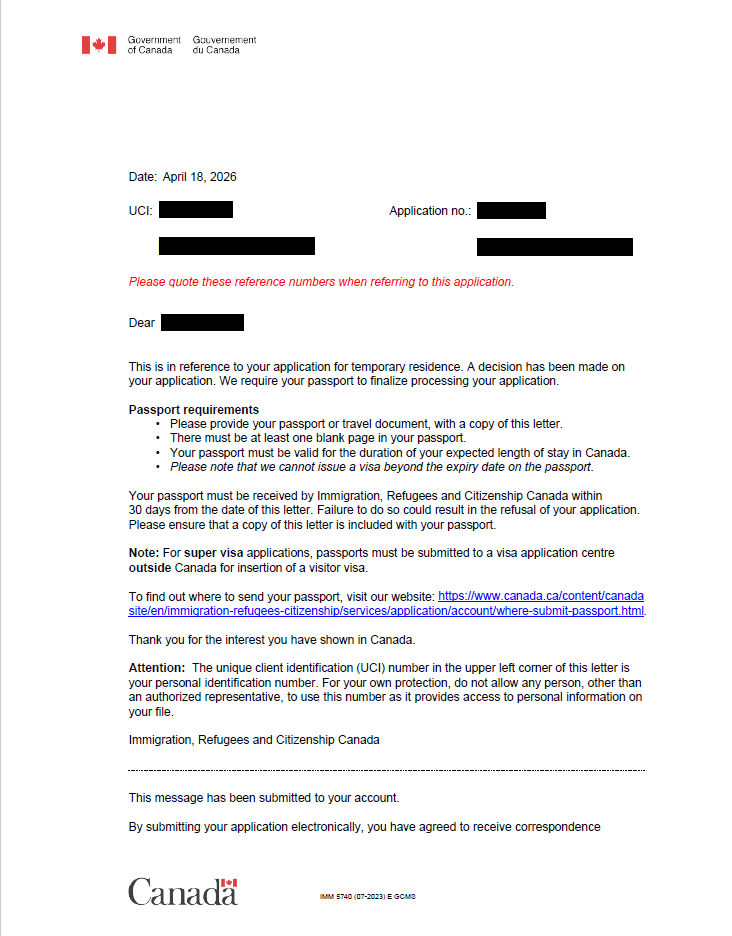
- A passport request or a refusal letter is issued, usually by email.
Files most often go wrong between steps three and five. An application can sit in an officer’s electronic queue and simply not move. Transfers between offices reset the practical clock even when the posted clock keeps running. Documents uploaded to the portal after submission do not generate a notification to the officer, which means a supplementary submission can arrive and be missed.
Triage, Chinook, and where the line sits
Some form of pre-assessment and triage has existed for as long as there have been visa applications. Volume has pushed it forward: with sustained backlogs and a stated federal objective of reducing Canada’s temporary resident population, offices are under pressure to move files quickly. The 2026 levels planning framework sets targets for new temporary resident arrivals in the hundreds of thousands per year, and those figures are revised, so check the current IRCC posting rather than relying on a number in an article.
On Chinook specifically, IRCC’s position, set out in its February 2022 briefing to the Standing Committee on Citizenship and Immigration, is that Chinook is a Microsoft Excel-based tool that displays information already stored in the Global Case Management System in a more usable layout; that it does not use artificial intelligence or advanced analytics for decision-making and contains no built-in decision-making algorithm; that an officer, not the tool, makes every final decision; and that it is not mandatory.
The line worth arguing is not whether triage exists. It is what triage is used for. Efficiency that leads to an approval is a risk-management choice IRCC is entitled to make. Efficiency that produces a refusal without a record showing the officer engaged with the evidence is a different matter, and after Vavilov the adequacy of that engagement is squarely reviewable. Where the concern is credibility or a fairness letter rather than the decision-maker’s authority, see our article on how officers test credibility and respond to procedural fairness letters.
Why the posted processing time does not match your file
IRCC measures processing times by looking backwards at how long it took to process 80 percent of applications in a category, and specifically the fastest 80 percent. The remaining 20 percent is not reflected in the posted figure. In theory that residual group is made up of complex cases. In practice it also absorbs files that were mishandled, transferred, or forgotten.
Two further points follow. The clock starts when IRCC receives a complete application and stops when an officer makes a decision, so incompleteness at the front end is expensive. And because the measurement is per office, the same category can move at very different speeds depending on where the file was dispatched. Not every processing time is published.
This is why no lawyer can responsibly promise you a date. Where a file is genuinely stalled rather than merely slow, the remedy is a court application rather than another enquiry, and we discuss that in our article on security screening delays and mandamus.
Where to send a request, and where not to
Getting a response from IRCC is, for most practitioners, the single most frustrating part of the process. The realistic options are the processing office or visa office directly, the IRCC web form, the case processing centre, the call centre, an access to information request, and, where there is a legal duty being ignored, the Federal Court.
The web form deserves a warning. Matching a web form submission to the correct file is difficult, and without a UCI or application number it is close to impossible, which is a common problem on paper-filed applications. Uploading directly into the IRCC portal is generally better, subject to file size limits, but again, nothing notifies the officer.
One ethical point. Using a personal relationship with a decision-maker to obtain privileged access to a file is not a shortcut, it is a conflict of interest, and it can damage the client’s case as well as the representative. Use the proper channels.
When a reconsideration request is worth sending
A refused application is not always the end of the road, but reconsideration is a narrow door. The legal doctrine of functus officio does not automatically bar reconsideration of a final decision (Canada (Minister of Citizenship and Immigration) v Kurukkal, 2010 FCA 230). IRCC’s own guidance for officers, however, says reconsideration should only be done where warranted, in exceptional cases, and that an applicant’s dissatisfaction or disagreement with the decision does not by itself qualify. The onus is on the applicant. The request should go back to the original decision-maker where possible, and otherwise to a decision-maker with the delegated authority to decide, and both the decision and the reasons are to be recorded in the notes.
IRCC’s guidance lists factors that may be relevant, which is a useful checklist when deciding whether to send a request at all:
- whether the principles of procedural fairness were not complied with when the decision was made;
- whether the applicant is asking for correction of a clerical or other error, for example a decision made by an officer who did not have the delegated authority;
- whether new evidence is based on facts that arose after the original decision, and is material and reliable, or whether it belongs in a fresh application instead;
- where evidence was available at the time of the original decision, why it was not submitted then, and whether it is material and reliable;
- the passage of time between the original decision and the request;
- whether there were concerns about fraud or misrepresentation of a material fact, either in the original decision or in the new submissions.
Tone matters. A reconsideration letter should be respectful, objective, and confined to showing which step of the procedure was not followed, with the evidence that establishes it. Quote the notes, identify the requirement, point to what was on file. There is no need to say that the officer did not read the application, and saying so does not help.
Where the problem is an error of law rather than a procedural slip, or where the timeline is short, judicial review may be the better route. The deadlines are strict and a reconsideration request does not extend them, which we explain in our guide to challenging a refusal at the Federal Court.
What this changes about how you build a file
- Assume the officer has limited time. Put the answer to the legal test at the front of your submissions rather than making the reader assemble it.
- Assume no one is notified when you upload something after submission. Say what you are adding and why, and, where it matters, submit it in a way that will be matched to the file.
- Assume the file may be assessed by an officer who has not seen this kind of case before. Explain the local system, the document, or the foreign legal category rather than assuming familiarity with it.
- Keep the record clean. If you may need to show later that a step was missed, you will need to show what was on file and when.
FAQ
Does a computer decide Canadian visa applications?
No. On IRCC’s own account, its triage tool displays case information more efficiently and contains no decision-making algorithm, and an officer makes every final decision. That does not mean the volume of files has no effect on the quality of individual decisions, which is a separate and legitimate concern.
Can I find out who refused my application?
The notes obtained through an access to information request will generally show the officer’s identifier, the assessment, and whether a second officer concurred. Names are often abbreviated or redacted.
Is a refusal invalid if the officer lacked delegated authority?
It may be open to challenge on that basis, which is why the point is worth checking against IRCC’s published instrument of delegation. Whether it succeeds depends on the ground of refusal and what the record shows, so this is a question to put to counsel with the notes in hand.
My application is far past the posted processing time. Is something wrong?
Not necessarily, because the posted time describes the fastest 80 percent of past applications rather than a service standard for your file. If the delay is long, unexplained, and enquiries have gone unanswered, that is the point at which a court remedy becomes worth assessing.
Should I send a reconsideration request or go to the Federal Court?
Reconsideration suits a clear, self-evident procedural or clerical error that can be explained in a paragraph. Judicial review suits an error in law or a decision that cannot be justified on the record. The court deadlines run regardless of whether a reconsideration request is pending, so the sequencing has to be decided early.
Ask us about your matter
Tell us where your file stands and we will reply within two business days. Please do not send documents or identification numbers in this first message.
Disclaimer: This article is for general information only and is not legal advice. Immigration law and IRCC/ESDC policy change frequently, and every case turns on its own facts. Reading this article does not create a lawyer–client relationship. Obtain advice tailored to your situation before you act.
Talk to a Canadian immigration lawyer. BridgePoint Law advises individuals and businesses across Canada — and on Canada–US–China cross-border matters — on refused applications, reconsideration requests and judicial review. Book a consultation with our team in Toronto and Kingston. We work in English, Mandarin, and Cantonese.