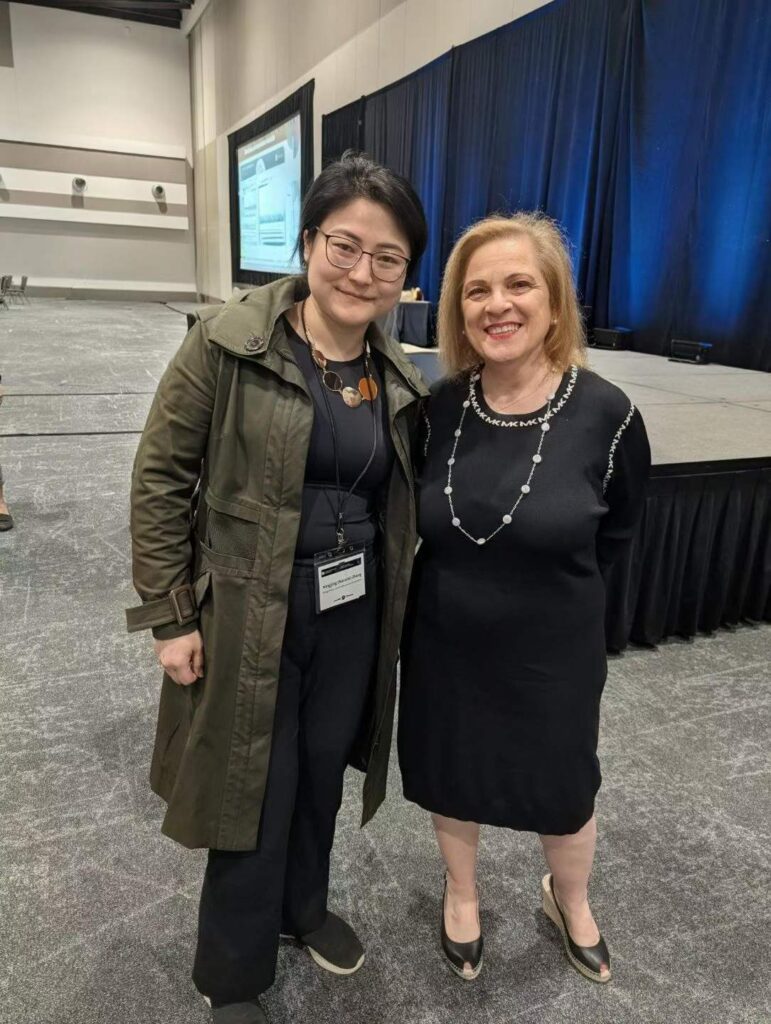
Photo: Dr. Ningjing (Natalie) Zhang with the Honourable Lena Metlege Diab, QC, Minister of Immigration, Refugees and Citizenship, at the Canadian Bar Association Immigration Law Conference, Toronto, May 2026.
A Moment That Defines a Generation of Immigration Practice
In May 2026, I had the honour of meeting the Honourable Lena Metlege Diab, QC, Canada’s Minister of Immigration, Refugees and Citizenship, after her keynote address at the Canadian Bar Association (CBA) Immigration Law Conference in Toronto. The room was full of refugee and immigration counsel from across Canada — lawyers who, every day, translate the country’s immigration system into reality for the people navigating it.
The Minister’s keynote was about the future of Canadian immigration: about how it will be administered, how decisions will be made, and what the role of the immigration bar will be inside a system that is increasingly governed by technology.
For our clients — and for every Canadian whose family member is waiting for an immigration decision — what the Minister said matters in a very concrete way.
The Two Sentences That Will Echo
The headline quote from the Minister’s address — and the one likely to appear in the next morning’s papers — was this:
“Our immigration reform is not about stepping away from immigration. It’s about leaning in to make the changes needed to keep Canada’s system sound for the next generation.”
This is the political framing of a complete recalibration of how immigration is being administered in Canada in 2026 and beyond.
But the sentence that mattered most to those of us who litigate immigration files at the Federal Court was a different one:
“These tools are not replacing human judgment. They will be supporting trained officers in making decisions. The reasoning behind the decision must be explainable and transparent, and the process must be fair and properly safeguarded.”
This is the Minister’s commitment, on the record, to the principles that ground judicial review of immigration decisions in Canada.
What This Means in Plain English
- Automation is coming to routine files. IRCC will deploy automated triage tools on straightforward applications so that human officers can focus their expertise on complex, sensitive, and compliance-heavy cases.
- Refugee, inadmissibility, and complex files will continue to receive human judgment. This is critical for clients whose cases involve country conditions, family vulnerabilities, criminal-immigration overlap, or refugee protection.
- The Minister committed to explainability, transparency, and procedural fairness. These are the procedural standards that ground every successful application for judicial review at the Federal Court of Canada. They are also the standards we will be holding the government to.
Why the Immigration Bar Was Watching
The Minister did something rare from the podium. She directly addressed immigration counsel as “those on the front lines who help ensure that procedural fairness is not just the phrase in the textbook, but a reality for the people navigating the system.”
For lawyers who spend their careers pushing back against unreasonable refusals, misinterpretations of country conditions, and procedural irregularities at IRCC and the Immigration and Refugee Board (IRB), this recognition matters. We will hold the government to its words at Federal Court — every time a decision falls short of the standards the Minister committed to from the podium at CBA.
What It Means for Your Immigration File
If you are an applicant whose file is currently with IRCC
Routine applications may move more quickly under the new automated triage. Complex files may take longer but will receive proper human attention. Either way, the procedural standards that protect your right to a fair decision are now publicly committed to by the Minister herself.
If you are a refused applicant considering judicial review
The Minister’s commitment to “explainability and transparency” is now part of the public record. Decisions that fail to meet these standards are precisely the decisions that the Federal Court can set aside. If you have received a refusal letter that does not adequately explain the reasoning, or that misapplies the law to your facts, judicial review may be available within strict deadlines:
- 15 days from the decision if you are inside Canada
- 60 days from the decision if you are outside Canada
If you are an immigrant founder, professional, or student
The Minister’s broader message — that Canada is “leaning in” on immigration rather than stepping away — means that the system itself is being recalibrated for long-term sustainability rather than retreat. The opportunities are still there, but the path to navigate them is becoming more technical, and the strategic timing of an application matters more than ever.
About BridgePoint Law
BridgePoint Law is a Canadian cross-border immigration and refugee litigation firm with offices in Kingston, Toronto, and Shanghai. We represent clients at:
- The Federal Court of Canada (judicial review)
- The Refugee Protection Division (RPD)
- The Refugee Appeal Division (RAD)
- The Immigration Appeal Division (IAD)
- Pre-Removal Risk Assessments (PRRA)
- Humanitarian and Compassionate (H&C) applications
- Every layer of IRCC application and review
Service is available in English, Mandarin, Cantonese, Spanish, French, Korean, Japanese, and Arabic.
Lead lawyer Dr. Ningjing (Natalie) Zhang is a refugee-turned-lawyer, an active member of the Canadian Association of Refugee Lawyers (CARL), the Ontario Bar Association (OBA), and the Law Society of Ontario’s Coach and Advisor Network (CAN). She attended the CBA Immigration Law Conference 2026 in Toronto.
Contact Us
If your file has been affected by IRCC processing delays, refused at any level, or if you simply want a second opinion on where your case stands under the new policy framework, contact us:
📞 (613) 417-1850
📧 info@bridgepointlaw.ca
🏢 Kingston (HQ) · Toronto · Shanghai
For Chinese readers, please see our Chinese-language version.
This article is general legal information, not legal advice on any specific case. Outcomes depend on the facts of your individual matter.