An AI founder asked me quietly this week whether he would still be in Canada when his venture money landed in his account.
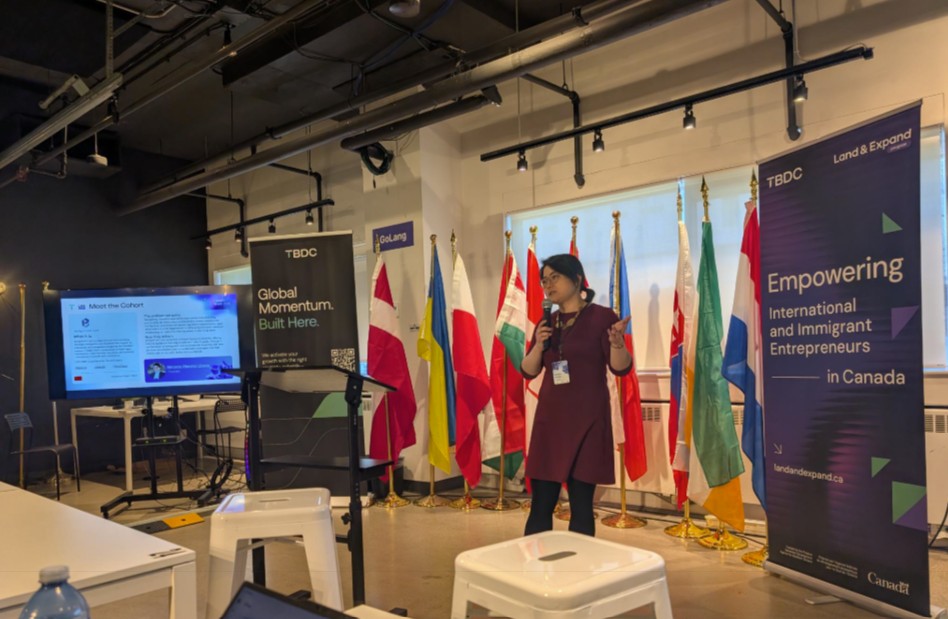
I was at TBDC Launch Week — the Toronto Business Development Centre’s flagship showcase for its AI and deep-tech incubator cohort. I went as an immigration lawyer who also runs her own firm, wanting to learn from other immigrant founders building hard things in Canada.
I left with two consultation appointments I did not expect, and a sharper version of a question I have been carrying for two years: can Canada actually retain the AI founders it keeps saying it wants?
The founder who has been waiting almost two years
The first founder approached me at the end of a panel. He told me he had submitted his permanent residence application almost two years ago through the Start-up Visa program. He is the technical lead on a B2B AI infrastructure company that recently went through partner due diligence with a US-based VC. Term sheet is signed. Money is closing in weeks.
His work permit was issued under his SUV designation letter. It will expire before his PR is decided. Two years in, IRCC’s processing time estimate for SUV PR has been quietly extended, and no AOR-based prediction is reliable. He has a wife. He has a child enrolled in JK starting September. He has investors who, the moment they sign, will expect him to be operational in Canada — not stuck at a border, not on a maintained-status loop, not strategizing a US E-2 backup with his immigration lawyer at midnight.
His question to me was not “what are my options.” His question was: “If the money lands and I am still here, what happens? If the money lands and I am not still here, what happens to the company?”
That is not a question about immigration law. That is a question about whether Canada’s AI strategy and Canada’s immigration system are even in the same room.
The Waterloo grad whose PGWP is expiring
The second founder found me during the networking break. He had graduated from the University of Waterloo two years ago, used his Post-Graduation Work Permit to bootstrap a generative-AI startup that now has paying enterprise customers, and is sitting in the STEM-stream Express Entry pool watching draws.
His PGWP expires in seven months. His CRS score sits in the band where 2026 draws have been hitting — but “have been hitting” is not the same as “will hit before my permit expires.” He has a Bridging Open Work Permit fallback only if he is invited and lodges an application. He has not been invited yet.
He told me he had been quietly fielding inbound offers from US AI labs for six months. Higher salary. O-1 sponsorship. A clear answer in 90 days. He had not said yes. Not yet. But he wanted to know how many months he had before saying no to the US became economically irrational.
That is not a brain-drain hypothetical. That is the brain drain, sitting in a TBDC chair, asking an immigration lawyer for a deadline.
What Canada’s AI Strategy keeps missing
My colleague Zeynab Ziaie Moayyed wrote a sharp piece earlier this year about the gap between Canada’s stated AI ambitions and the immigration plumbing that should support them. She pointed out, correctly, that the Pan-Canadian AI Strategy was designed in a world where “talent attraction” meant “the talent will figure out the immigration on their own.”
That world is gone.
The talent now does the math. The talent knows that an O-1 application in the US closes in 90 days with premium processing. They know that a Canadian SUV file with a B2B AI infrastructure company, founder relocation, and a real cap-table can wait two years and still get a non-answer. They know that the PGWP is a one-shot, that the IRCC processing dashboard is a polite fiction, and that a STEM Express Entry pool that produces predictable draws would be a competitive advantage Canada is choosing not to build.
The founders I met at TBDC Launch Week are not asking for an easier path. They are asking for a predictable one.
Why I was in that room
I am an immigration and refugee lawyer. I am also, separately, the founder of a cross-border law firm that operates in Kingston, Toronto, and Shanghai, in three working languages, with no investor capital. My background is refugee resettlement. My day job is representing people, including AI founders, who are trying to stay in Canada legally.
I went to TBDC Launch Week to learn — not to pitch. I wanted to understand how AI founders at Canada’s flagship deep-tech incubator are actually thinking about Canada in 2026. Where they are seeing pull. Where they are seeing pressure. What they are not telling their boards.
The honest answer, from a week of conversations: they are thinking about Canada the way I think about staying anywhere — with one eye on the door, and the other on the people they would be leaving behind. That is not a complaint. That is what every immigrant founder I have ever represented has done, including me.
What I told both founders
I told the SUV founder that his work permit can usually be extended on a one-time basis while his PR is pending, that we should be screening now for an O-1 or L-1 contingency in case his VC pushes for a US entity restructure, and that he should not wait for the AOR letter to give him certainty — there is no certainty coming. He should be running a parallel-path strategy starting Monday.
I told the PGWP founder that the bridging permit window matters more than the Express Entry pool, that he should be filing his profile updates monthly to stay in the highest CRS band his credentials support, and that if he is going to spend the next six months waiting for an ITA, he should also spend the next six months building the US O-1 documentary record. Not because he should leave. Because if he stays, he stays by choice, not by inertia.
Both of them booked consultations the next day.
What I am taking back to my own practice
Three things.
One. The AI founder market is underserved by immigration counsel who understand both how a term sheet works and how a SUV file moves. Most immigration lawyers do not read cap tables. Most corporate lawyers do not read CRS scores. The founders are stuck in the middle.
Two. Parallel-path planning is not aggressive. It is responsible. If your client’s Canadian immigration outcome is uncertain past 90 days, you should have a US backup mapped before they need it. That is not disloyalty to Canada. That is loyalty to the client.
Three. I am going back to TBDC. The conversations at Launch Week were the most clarifying I have had about cross-border AI immigration this year. If you are an AI or deep-tech founder reading this and your immigration timeline is starting to compress against your funding timeline — please reach out. Early.
About BridgePoint Law (侨达律师事务所)
BridgePoint Law (侨达律师事务所) is a boutique Canadian cross-border firm founded by Dr. Ningjing (Natalie) Zhang. We practise immigration and refugee law, real estate, civil litigation, and wills and estates, with offices in Kingston, Toronto, and Shanghai. We are licensed lawyers — not consultants — representing founders and families up to and including the Federal Court of Canada. Working languages: English, Mandarin (普通话), Cantonese (廣東話).
For a confidential consultation, call (613) 417-1850 or email info@bridgepointlaw.ca.
Read this post in 中文版本.